
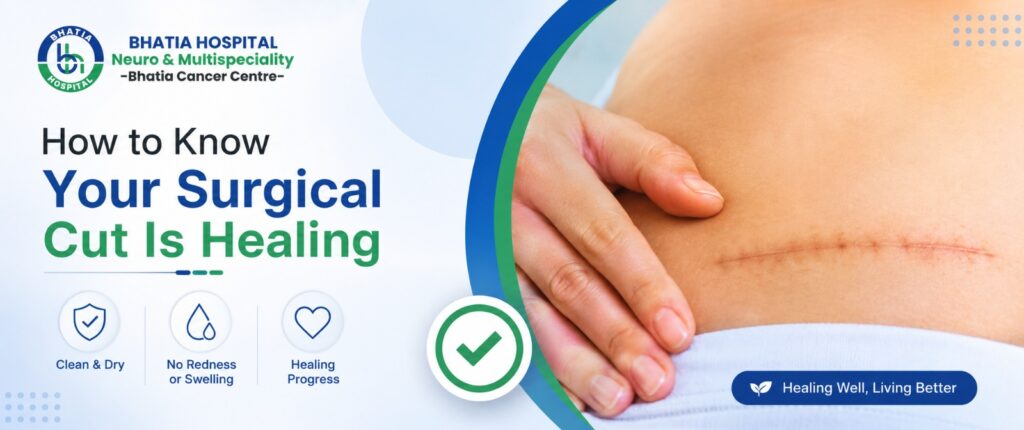
How to Know Your Surgical Cut Is Healing Right
Undergoing surgery is an important step toward recovery. However, taking proper care of your surgical incision afterward is just as important. While most surgical cuts heal without problems, it is essential to know the signs of healthy healing and recognize when something may be wrong. Therefore, understanding the normal healing process can help you recover safely and avoid complications.
At Bhatia Hospital, our experienced surgeons and healthcare professionals provide expert post-operative care, personalized wound management, and continuous support to ensure a smooth recovery after surgery.
What Is a Surgical Cut?
A surgical cut, also known as surgical incision, is a controlled opening made by a surgeon during an operation. After the procedure, the incision is carefully closed using stitches, staples, surgical glue, or adhesive strips. With proper care, most surgical wounds heal gradually over several weeks.
Signs Your Surgical Cut Is Healing Properly
1. Mild Redness Around the Incision
A small amount of redness around the edges of the incision is normal during the first few days after surgery. In fact, this is part of the body’s natural healing response.
Healthy redness:
- Stays close to the incision
- Gradually fades over time
- Is not spreading
If the redness becomes darker or spreads, it may require medical evaluation.
2. Swelling Slowly Decreases
Some swelling is expect after surgery. However, the swelling should gradually improve over the following days.
Normal healing includes:
- Mild swelling near the incision
- Gradual reduction in swelling
- Improved comfort each day
Increasing swelling may indicate an infection or fluid buildup.
3. Pain Improves Each Day
It is normal to experience discomfort after surgery. However, the pain should slowly become less severe as the wound heals.
A healthy healing process usually includes:
- Mild to moderate soreness
- Less pain each day
- Pain controlled with prescribed medication
If pain suddenly becomes severe or worsens after improving, contact your healthcare provider.
4. The Incision Remains Closed
A properly healing surgical wound should stay closed while new tissue forms underneath.
Healthy incision signs include:
- Edges remain together
- No separation of the wound
- Stitches or staples stay securely in place until removal
Keeping the incision clean and dry supports proper healing.
5. Minimal Clear Drainage
Some clear or slightly pink fluid may drain from the incision during the first day or two. This is often a normal part of healing.
However, the drainage should:
- Decrease over time
- Remain clear or light pink
- Stop within a few days
Yellow, green, thick, or foul-smelling drainage should be evaluated by a doctor immediately.
Warning Signs Your Surgical Cut May Not Be Healing Properly
Although many surgical wounds heal normally, certain symptoms require prompt medical attention.
Seek medical care if you notice:
- Increasing redness around the incision
- Swelling that continues to worsen
- Thick yellow or green pus
- Bad odor from the wound
- Fever above 100.4°F (38°C)
- Severe or increasing pain
- The incision opens or separates
- Heavy bleeding that does not stop
Early treatment can prevent serious complications and support faster healing.
Tips to Help Your Surgical Cut Heal Faster
Proper wound care plays a major role in recovery. Therefore, follow your surgeon’s instructions carefully.
Here are a few helpful tips:
- Wash your hands before touching the incision.
- Keep the wound clean and dry.
- Change dressings exactly as instructed.
- Avoid scratching or picking at the incision.
- Eat a healthy diet rich in protein, vitamins, and fluids.
- Avoid smoking, as it can delay wound healing.
- Take all prescribed medications as directed.
- Attend all scheduled follow-up appointments.
These simple steps can reduce the risk of infection and promote healthy healing.
When Should You Contact Your Doctor?
You should contact your doctor immediately if:
- You develop a fever.
- The wound starts draining pus.
- The incision becomes increasingly painful.
- The wound opens after surgery.
- You notice excessive bleeding.
- The skin around the incision becomes hot or rapidly swollen.
Prompt medical attention can help prevent complications and improve recovery.
How Bhatia Hospital Supports Your Recovery
At Bhatia Hospital, we understand that recovery continues even after surgery is complete. Therefore, our dedicated medical team provides comprehensive post-operative care to help patients heal safely and comfortably.
Our post-surgical care services include:
- Surgical wound assessment
- Professional dressing changes
- Infection prevention and treatment
- Pain management
- Follow-up evaluations
- Personalized recovery guidance
Our goal is to ensure every patient experiences a smooth and successful healing journey.
Conclusion
A healthy surgical incision usually shows gradual improvement with less pain, reduced swelling, minimal drainage, and a securely closed wound. However, warning signs such as increasing redness, pus, fever, severe pain, or wound separation should never be ignore. Therefore, early medical evaluation is essential to prevent complications and support proper healing.
If you have concerns about your surgical wound, visit Bhatia Hospital for expert post-operative care, accurate wound assessment, and compassionate medical support.
Frequently Asked Questions (FAQs)
1. How long does a surgical cut usually take to heal?
Most surgical incisions begin healing within 1–2 weeks, while complete healing may take several weeks or months depending on the type of surgery and your overall health.
2. Is itching around a surgical incision normal?
Yes. Mild itching is a common sign of healing as new skin forms. However, avoid scratching the incision to prevent infection.
3. When should I worry about my surgical wound?
You should contact your doctor if you notice increasing redness, swelling, pus, fever, severe pain, heavy bleeding, or if the incision starts to open.
4. Can I shower after surgery?
This depends on your surgeon’s instructions. Many patients can shower after 24–48 hours, but the incision should be kept clean and protected as advised.
5. How can Bhatia Hospital help with post-surgical wound care?
At Bhatia Hospital, we provide expert incision assessment, wound dressing, infection management, pain control, follow-up care, and personalized recovery plans to help patients heal safely and comfortably.