
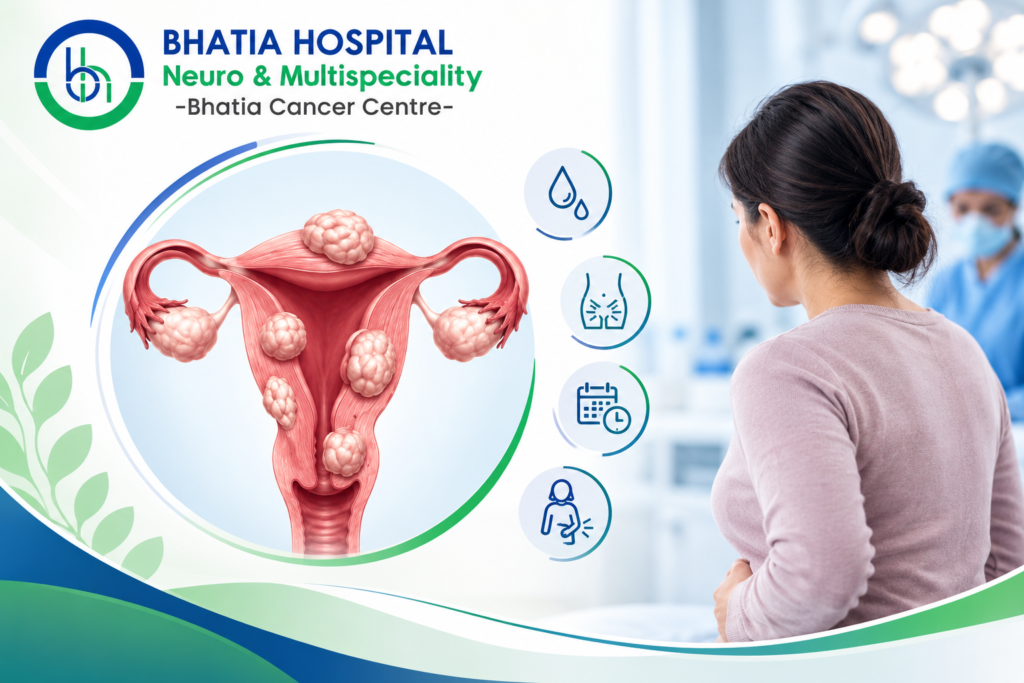
When Fibroids Need Surgery Know the Warning Signs
Uterine fibroids are common and often cause no symptoms.
However, some fibroids can cause heavy bleeding, pain, pressure, or fertility problems.
So, when do fibroids need surgery?
There is no single fibroid size that automatically means surgery is needed.
Instead, doctors look at several factors before recommending treatment. These include your symptoms, fibroid size, location, number, age, and future pregnancy plans.
At Bhatia Hospital Neuro & Multispeciality, women can discuss their symptoms and treatment options with a qualified medical team.
What Are Uterine Fibroids?
Uterine fibroids are non-cancerous growths that develop in or around the uterus.
They can vary in size and number. Some women have one fibroid, while others have several.
Many fibroids do not need treatment. However, symptoms can affect daily life when fibroids grow or press on nearby organs.
Common symptoms include:
- Heavy or prolonged periods
- Pelvic pain or pressure
- Pain during periods
- Frequent urination
- Constipation
- Lower back pain
- Bleeding between periods
- Difficulty becoming pregnant
The location of a fibroid also matters. A smaller fibroid can sometimes cause major symptoms if it affects the uterine cavity.
When Do Fibroids Need Surgery?
1. Heavy Bleeding Is Affecting Your Health
Heavy menstrual bleeding can lead to iron-deficiency anemia.
It can also cause tiredness, weakness, and reduced quality of life.
If medicines do not control the bleeding, your gynecologist may discuss a procedure or surgery.
2. Fibroid Pain Is Severe or Persistent
Not every painful fibroid needs surgery.
However, ongoing pelvic pain deserves medical evaluation.
Your doctor may recommend treatment when pain continues despite medicines or affects normal activities.
3. The Fibroid Causes Pressure Symptoms
Large fibroids can press against nearby organs.
As a result, some women may experience frequent urination or constipation.
A large fibroid may also cause pelvic heaviness or abdominal enlargement.
4. Fibroids Affect Fertility
Some fibroids can affect fertility, especially when they change the shape of the uterine cavity.
Therefore, women trying to become pregnant may need a detailed assessment.
The treatment plan should also consider future pregnancy goals.
5. The Fibroid Grows Rapidly
A change in fibroid size may require further evaluation.
Your doctor may recommend imaging tests to understand the growth and location.
Rapid growth does not automatically mean cancer. However, it should not be ignored.
6. The Diagnosis Is Unclear
Sometimes, imaging does not provide enough information.
Your doctor may recommend further testing when another type of growth needs to be ruled out.
This approach helps doctors choose the safest treatment.
What Size Fibroid Requires Surgery?
There is no fixed size that means a fibroid needs surgery.
A 4 cm fibroid may cause severe symptoms in one woman.
Meanwhile, a larger fibroid may cause few or no problems in another woman.
Doctors consider the complete picture before recommending surgery.
They may assess:
- Fibroid size
- Fibroid location
- Number of fibroids
- Symptoms
- Rate of growth
- Age
- Pregnancy plans
- Previous treatments
- Overall health
Therefore, the question should not only be, “How big is the fibroid?”
A better question is, “What problems is the fibroid causing?”
When Is a Fibroid Considered Too Large?
A fibroid may become a concern when its size causes symptoms or changes the uterus.
Large or deeply placed fibroids may require more detailed treatment planning.
However, size alone does not decide whether surgery is necessary.
Your gynecologist may use ultrasound to measure the fibroids and assess their location. MRI may also help in selected cases.
Can Large Fibroids Be Removed Without Surgery?
Sometimes, yes.
Treatment depends on the fibroid and your individual situation.
Some women may be suitable for non-surgical or less invasive options.
These can include medicines, uterine artery embolization, or selected ablation procedures.
However, these options are not suitable for every woman.
Your doctor should explain the benefits, risks, and expected results before treatment.
Do Painful Fibroids Need to Be Removed?
Not always.
Mild pain may improve with medicines or other treatments.
However, severe or persistent pain needs proper evaluation.
If pain affects sleep, work, exercise, or daily activities, speak with a gynecologist.
Surgery may become an option when other treatments do not provide enough relief.
Can Heavy Bleeding From Fibroids Require Surgery?
Yes, in some cases.
Heavy bleeding can cause anemia and interfere with everyday life.
Doctors may first consider medicines or other treatments.
If symptoms continue, surgery may become appropriate.
The right choice depends on your health and treatment goals.
Is Surgery Necessary for Multiple Fibroids?
Not necessarily.
Having several fibroids does not automatically mean you need surgery.
Doctors consider their size, location, symptoms, and effect on the uterus.
However, multiple large or deep fibroids can make treatment more complex.
In some cases, abdominal myomectomy may be considered for multiple or very large fibroids.
When Should You Consider a Myomectomy?
A myomectomy removes fibroids while keeping the uterus.
It may be considered when fibroids cause significant symptoms or affect fertility.
This option can be important for women who want to preserve their ability to become pregnant.
There are different types of myomectomy.
These include hysteroscopic, laparoscopic, robotic, and abdominal approaches.
The best approach depends on the fibroid’s size, number, and location.
When Is Hysterectomy Recommended for Fibroids?
A hysterectomy removes the uterus.
Doctors may consider it when other treatments have not worked, are unsuitable, or fibroids are very large.
It permanently prevents future pregnancy.
Therefore, your doctor should discuss this decision carefully with you.
A hysterectomy may be appropriate for some women.
However, it is not automatically the first choice for every patient with fibroids.
Do Fibroids Need Surgery After Menopause?
Fibroids often shrink after menopause because hormone levels fall.
Therefore, many women do not need treatment after menopause.
However, new symptoms or bleeding after menopause should receive medical attention.
Your doctor may recommend evaluation to understand the cause.
Do not assume that postmenopausal bleeding is caused by fibroids.
How Are Fibroids Evaluated Before Surgery?
Your doctor will first discuss your symptoms and medical history.
A pelvic examination may also help assess the uterus.
Ultrasound is commonly used to identify and measure fibroids.
In selected cases, your doctor may recommend MRI or other tests.
The evaluation helps your doctor understand:
- Where the fibroid is located
- How large it is
- How many fibroids are present
- Whether it affects the uterine cavity
- Whether another condition needs evaluation
What Are the Main Surgical Options?
The surgical approach depends on your condition.
Myomectomy
Myomectomy removes fibroids while preserving the uterus.
It may suit women who want to preserve fertility.
Hysteroscopic Myomectomy
This approach may suit certain fibroids located inside the uterine cavity.
The surgeon reaches the fibroid through the vagina and cervix.
Laparoscopic or Robotic Myomectomy
These approaches use small abdominal incisions.
They may suit selected patients with suitable fibroid size and location.
Abdominal Myomectomy
This approach uses a larger abdominal incision.
Doctors may consider it for multiple, very large, or deeply placed fibroids.
Hysterectomy
Hysterectomy removes the uterus.
It provides a permanent solution for fibroids because the uterus is removed.
Our Approach to Fibroid Care
At Bhatia Hospital Neuro & Multispeciality, treatment should begin with a proper assessment.
The goal is not simply to remove a fibroid.
The goal is to choose an appropriate treatment for your symptoms and needs.
Your consultation may include:
- Understanding your symptoms
- Reviewing your medical history
- Assessing your menstrual pattern
- Reviewing ultrasound or other imaging
- Discussing fertility plans
- Explaining available treatment options
- Discussing surgery when appropriate
- Planning follow-up care
This patient-first approach helps you make an informed decision.
Why Choose Bhatia Hospital Neuro & Multispeciality?
Choosing treatment for fibroids can feel stressful.
You may also have questions about fertility, surgery, recovery, or future health.
A careful consultation can help you understand your options.
At Bhatia Hospital Neuro & Multispeciality, patients can discuss their concerns with the medical team and understand the next steps.
The focus should remain on appropriate diagnosis, clear communication, and patient safety.
When Should You See a Gynecologist?
Consider booking a consultation if you have:
- Very heavy periods
- Long-lasting menstrual bleeding
- Persistent pelvic pain
- Increasing abdominal size
- Frequent urination
- Constipation linked with pelvic pressure
- Difficulty becoming pregnant
- New symptoms after menopause
- A fibroid that appears to be growing
Do not wait for symptoms to become severe.
Early evaluation can help you understand whether monitoring, medicines, a procedure, or surgery makes sense.
FAQs
What size fibroid requires surgery?
No single size requires surgery. Doctors consider symptoms, location, number, growth, age, and fertility plans.
How do you know if fibroids need surgery?
Surgery may be considered when fibroids cause severe symptoms or affect fertility. It may also help when other treatments do not work.
Can large fibroids be removed without surgery?
Some large fibroids may have non-surgical or less invasive treatment options. However, suitability depends on the individual case.
Do painful fibroids need to be removed?
Not always. Persistent or severe pain needs evaluation, and surgery may be considered when other treatments fail.
Is surgery necessary for multiple fibroids?
No. Multiple fibroids do not automatically require surgery.
The decision depends on their size, location, symptoms, and your treatment goals.
Conclusion
So, when do fibroids need surgery?
Usually, surgery becomes an option when fibroids cause significant symptoms or create other health concerns.
However, size alone does not decide the treatment.
Your symptoms, fibroid location, number, growth, age, and pregnancy plans all matter.
If you’re concerned about fibroids, a gynecology consultation can help you understand your options.